
Bar Kap
The House The Experiences Menu What’s On Jing Studio Visit Reservations

How BAR KAP Turns Heritage Into an Archive of Cocktails

How BAR KAP Turns Heritage Into an Archive of Cocktails

A drink can hold a memory the same way a building can. At BAR KAP, that idea is not a metaphor. As a heritage cocktail bar built inside a national monument, every pour here is meant to carry something forward rather than simply taste good in isolation.

The menu calls itself the Kapitan’s Archives, and it means it literally. Every cocktail corresponds to an object from a collection that never existed, a scale, a lantern, a censer, a family seal, and yet each one feels as though it should have. The House does not give itself away at once. It reveals itself the way an archive does: not in order, not all at once, but through whatever a guest chooses to notice first, a symbol, a flavour, a story, or a hunch.

Kapitan: Trade and Arrival

This is the era of Tan Yeok Nee himself, trade, movement, self-making. The house here reads as a declaration rather than an inheritance, built by a man who arrived from elsewhere and made his stature through will and enterprise.

The drinks draw from that same energy: confident, outward-looking, restless, shaped by a life built through motion and intent. Pepper Peddler carries that spirit most directly, baijiu, gin, makgeolli and long pepper brought together in one glass, tracing the old spice routes that once moved through this stretch of the region. It is a drink built the way the house itself was, out of movement, negotiation, and things arriving from elsewhere to make something new.

Stationmaster: Order and Movement

After Tan Yeok Nee, the railway reshaped the house. Front land was taken for the station, and what remained learned a new discipline: schedules, thresholds, order.

The drinks in this chapter are composed rather than loud, exacting, quietly formal. A different kind of power than the one before it, less personal, more procedural, but no less defining. Tank Road holds that structure precisely, scotch and Campari cut with burnt orange, bay and grapefruit, built with the same restraint as a man keeping time rather than making conversation. Nothing about it is rushed. Everything about it is exact.

Order: Restraint and Care

The charitable era, first St Mary’s Home, then the Salvation Army, asked something different of the house. Status gave way to purpose. Display gave way to devotion.

This chapter draws on ritual, repetition, care and restraint, and the drinks are built the same way: inward, balanced, detailed, shaped by a house once organised around duty rather than display. Lights Out embodies that quiet precision, dry gin and secco vermouth layered with mandarin and pandan, a drink built for attention rather than spectacle. It asks to be noticed slowly, the way duty is noticed only in hindsight.

Dynasty: The Present Chapter

This is the house in the present tense. Not frozen, but held, interpreted, carried forward. Stewardship over ownership. A future built equal to its past, where old meanings are neither copied nor discarded outright.

Fittingly, this is the chapter that draws from every layer that came before it: clear, confident, lasting. TCM Drawer No. 3 closes the archive with soy milk, ginger, honeydew and gula melaka, ingredients that read as distinctly local and distinctly domestic, the kind found in a drawer rather than a display case. It is the zero-proof drink in the collection, and perhaps the most fitting one to end on: a house that has learned, after four chapters, how to simply hold what it has.

One Archive, Many Ways In

BAR KAP is not read in a straight line. There is no correct place to begin, and no drink here is meant to stand alone. Follow the Pepper Peddler into trade and arrival, Tank Road into order and procedure, Lights Out into restraint and devotion, or TCM Drawer No. 3 into the house as it stands today.

Each one holds a single fragment: an era, an object, a mood carried forward from a house that has been many things to many people. Taken together, they become less a menu than a house slowly opening, one glass, one chapter, one door at a time.

View our cocktail menu and make a reservation today to start working through the archive for yourself.

What Is BAR KAP? A Modern Cocktail Bar Inside a National Monument

What Is BAR KAP? A Modern Cocktail Bar Inside a National Monument

Singapore has no shortage of cocktail bars, but few can claim an address inside a national monument. BAR KAP does exactly that, occupying Singapore’s only grand mansion built in the 1880s, with a past far removed from nightlife, and turning it into a place built around good drinks and good company. The house is treated as a working room rather than a display case. Nothing here asks you to file past exhibits. Everything here asks you to sit down, order something well made, and stay a while.

A Modern Heritage Bar, Not a Museum

That is the short answer to what BAR KAP is: a modern heritage bar built inside a National Monument, where the drinks sit alongside the building’s history rather than compete with it.

The concept calls itself the Kapitan’s Archives, and it means that literally. Every cocktail on the menu corresponds to an object from a collection that never existed, a scale, a lantern, a censer, a family seal, and yet each one feels as though it should have.

Four Chapters, One Menu

The menu moves through four chapters, each pulled from a different era of the house’s story:

  • Kapitan, for the era of Tan Yeok Nee himself: confident, outward-looking drinks.
  • Stationmaster, for the years the railway reshaped the house: composed, exacting pours.
  • Order, for the house’s charitable era under St Mary’s Home and the Salvation Army: quiet, restrained drinks
  • Dynasty, for the house as it stands today: layered pours that draw from every era before it, holding the past without freezing it in place.

None of it is delivered as a lecture. The team share what is useful when you ask, and let the drink do most of the talking otherwise.

Craft Over Costume

Craft runs through the room as much as story does. The ceramics, the carved details and the qiàn cí roof work outside all point to Teochew makers whose skill shaped this house long before anyone thought to put a bar inside it. BAR KAP applies that same regard for the hand that made something to the people mixing your drink and the makers behind the vessels it arrives in.

Some elements of the house are original, some have been carefully restored, and some are new additions built to sit comfortably alongside the old. The team can tell you which is which if you are curious, though nobody is required to ask.

Service That Follows the Building's Lead

Service follows the same logic as the building. Nothing is rushed, and nothing is overexplained. You are there to have a good evening in a genuinely old room, not to sit through a history lesson with a cocktail attached.

For anyone who spends time thinking about buildings, craft or a well-made drink, BAR KAP gives all three a shared table. The house provides the setting. The archive gives you a reason to stay.

Book Your Table

If you would like to see it for yourself, book a table at BAR KAP and let a century-old room introduce you to a drink built just for tonight.

Four Rooms, One House: A Guide to BAR KAP’s Spaces

Four Rooms, One House: A Guide to BAR KAP's Spaces

The House of Tan Yeok Nee was built to hold many lives at once – a family home, station master house, a place of learning, all within the same walls at different times. That layering never left the building. It simply changed form.

BAR KAP, a boutique cocktail bar set inside this conserved National Monument on Orchard Road, now moves through the house one room at a time. Each space carries forward a different piece of what came before. Some rooms open outward, built for gathering. Others turn inward, built for stillness. None of them ask to be experienced the same way.

What follows is a walk through all four, room by room, so the next visit can be chosen with a little more intention.

The Main Hall

The Main Hall was the house’s centre of gravity – the room every arrival passed through, and every gathering returned to.

It holds a long communal table now, but the instinct is the same one the house was built for: bring people together under one roof and let conversation do the rest. Morning light moves across the room slowly, turning the space contemplative, almost private, before the evening rush transforms it into something entirely different.

Within the House of Tan Yeok Nee, this is the room without pretense. It doesn’t ask you to lower your voice or lean in – it simply holds whatever energy the night brings.

A room that begins the evening, and often ends up being where it’s remembered.

The Carriage Room

The Carriage Room was once a threshold at the edge of arrival, a porch where movement paused before entering the House.

It now holds the Kapitan’s collection of curiosities. Objects gathered in transit, arranged not as display but as quiet invitation. Each detail carries a suggestion of discovery, revealed only as the room settles.

Time moves differently here, slower and more layered. A room where stories deepen and the night reveals itself in its own rhythm.

If you are marking something worth remembering or simply want a corner away from the main crowd, this is the room to book.

The Chamber

The Chamber once held learning and medicine – a room built for precision, for people who came seeking something specific and left changed by it.

That instinct hasn’t left the room. The pours here are deliberate, drawing on apothecary tradition, each one built in layers meant to be noticed rather than rushed through. Nothing about The Chamber wants to be consumed quickly.

Quiet by day, intimate by night – the kind of room where conversation naturally drops to the register it was always meant to be at.

A room for private events or a smaller group who prefer to talk over their drinks.

Jing Studio

Jing Studio sits at the edge of the house, apart from the rest – a room built for a different kind of attention altogether. A dedicated daytime tea sanctuary, where the house slows down before the rest of it wakes up for the evening.

Here, a tea master brews table-side, and the ritual is the point: ceramics warming, steam rising, each pour given the time it asks for.

One House, Many Rooms to Return To

Four rooms, shaped by four different eras of the same house – that’s the simplest way to describe BAR KAP. Nothing here was built to be seen all at once. It reveals itself one room, one visit at a time.

Gather at the Main Hall. Disappear into the Carriage Room. Slow down in The Chamber. Sit with tea at Jing Studio. Each one asks for something different of the evening, and gives something different back.

Explore the space at BAR KAP, then book your table, and find out which room finds you first.

Inside the House of Tan Yeok Nee: Singapore’s Last Grand Mansion
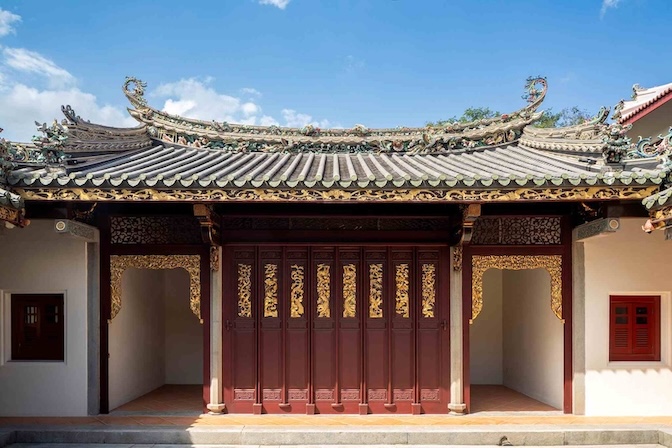
Inside the House of Tan Yeok Nee: Singapore's Last Grand Mansion

Photo Credit: Darren Soh

Tucked along Clemenceau Avenue, a Teochew courtyard mansion has watched over more than a century of Singapore’s history. Built between 1882 and 1885, the House of Tan Yeok Nee is the last of what were once known as the city’s Four Grand Mansions built by Teochew towkays in nineteenth-century Singapore. This one remains, and it now holds one of the city’s most distinctive addresses for dining and drinks.

The house carries an official name few visitors ever learn: 资政第, or Zi Zheng Di in Teochew, meaning roughly “the residence of a second-rank official.” Tan Yeok Nee hadn’t been born into that rank. He arrived in Singapore as a poor cloth peddler, built his fortune in Johor through gambier and pepper, and modelled this house after a cluster home he was building in his own hometown in Chaozhou, right down to the craftsmen who are believed to have crossed the sea to build both.

A Building That Outlived Its Owner

Tan Yeok Nee didn’t leave by choice. At the turn of the twentieth century, the British government seized the front section of his property to build a railway line, and the noise and dust eventually drove him to sell. What followed was a string of occupants: a railway manager, then St. Mary’s Home from 1906, then the Salvation Army from 1938.

Each left a mark still visible today. The Gothic lancet windows lining the Main Hall have nothing to do with Teochew architecture; they were installed when the space served as a chapel. Traditional Teochew houses were built with no windows at all on the front facade, an inward-looking principle known as 立面不开窗. The windows facing Clemenceau Avenue today are a later addition, worth noticing precisely because they shouldn’t be there.

The house was declared a National Monument in 1974, recognising it as the last of the Four Grand Mansions.

A Heritage Cocktail Bar Rooted in the Past

That layered past is exactly what BAR KAP, a heritage cocktail bar inside the House of Tan Yeok Nee, draws on. Rather than treating the mansion as a relic behind rope barriers, BAR KAP moves through the house room by room, with cocktails and food built around objects and eras from the building’s own story. The result feels less like a history lecture and more like being let into someone’s private rooms.

Details Worth Noticing on a Visit

  • The Gothic lancet windows inside the Main Hall, a holdover from the building’s decades as a chapel.
  • The balustrades lining the front porch, reinstated during conservation based on nothing but mortise holes in the stone floor, evidence something once stood there.

Hospitality, Not a History Lesson

Service inside leans warm and unhurried rather than formal. Staff are trained to answer questions about the house honestly, including admitting when a detail is uncertain rather than filling the gaps with invented stories, much like the house’s own history, recovered through mortise holes, oral accounts and old photographs rather than a single unbroken record.

What makes the House of Tan Yeok Nee stand out isn’t just its age or its rarity, though both are true. It’s the fact that a building this layered is still being used the way it always was: for gathering, conversation and good drinks, rather than sitting empty as a museum piece.

Plan Your Visit

Make a reservation today for an evening shaped by over a century of the building’s own history.