

The Kapitan Era: The First Chapter of BAR KAP
The Man Who Built The House
Tan Yeok Nee arrived in Singapore as a cloth peddler with nothing to his name. He built his fortune through gambier and pepper, later expanding into spirits and opium farms across Johor and Singapore, and returned to Singapore in 1875 with enough standing to commission a mansion that announced exactly who he’d become.
This was a house built as declaration, not inheritance, raised by a man who arrived from elsewhere and made his stature through will.
A Detail Worth Slowing Down For
Look closely at the gold on the house’s carved fascia boards and sculptures, and you’ll notice something deliberate: it isn’t uniformly bright.
Some elements gleam in full gold leaf, while others are dulled with a layer of shellac, giving them a quieter, bronzed cast. Craftsmen of the era called this restraint 藏金不露 — “to conceal gold without revealing it.” Tan Yeok Nee could have gilded every surface without a second thought. Instead, the wealth is there, but it’s tempered, never shouted.
It’s a small piece of the house’s material language, the same instinct for considered, unhurried craft that runs through everything Tan Yeok Nee built here.
Drinking The Kapitan Story
The Kapitan sequence carries that same confident, outward-looking energy into the glass, each cocktail shaped by trade and movement rather than one repeated flavour idea.
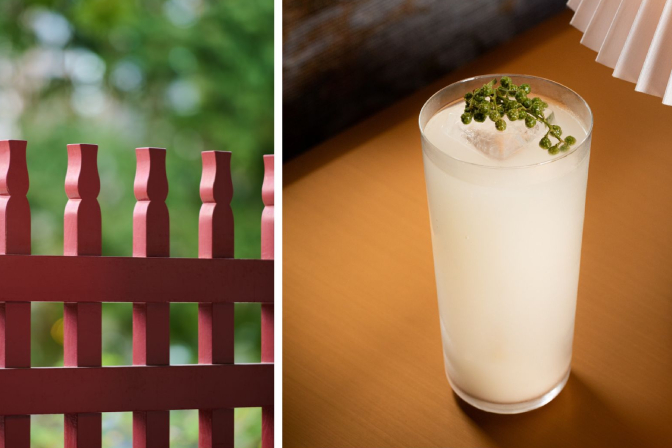
- Pepper Peddler leads the era. Baijiu, gin, makgeolli, firewater and fizz built around pepper itself, the spice that funded the Kapitan’s empire. Peppery, bright, sparkling and assertive, it’s the sharper edge of the menu and the house’s recommended starting point.
- Manifest reads like a small cargo list. Gin and sherry meet nashi, lemon, purple rice and sesame, treating fruit and grain the way a merchant might treat a shipment, worth logging and worth tasting slowly. Dry-fruited, nutty and quietly savoury.
- Maiban softens the register. Vodka, coconut, lime and raspberry lifted with egg white make for a creamy, tart and approachable opening drink, a gentler side of the same restless spirit.
- Gong Fu Merchant, the era’s zero-proof serve, channels discipline over spectacle. Aged tea, vinegar, longan, osmanthus and honey build a tea-led, floral drink with a long, tart finish, proof that restraint was as much a trade skill as ambition.
Together, they let you taste the mindset that built the house around you.
What Comes Next
The Kapitan didn’t stay in this house forever. British acquisition of the property brought a different chapter to these rooms, one shaped by the railway rather than trade. The Station Master Era takes its cue from that shift: movement, signal and timing in place of arrival and ambition. Confident, smoky, occasionally mechanical, the drinks that follow carry routes and signals through the glass, and they’re a story worth coming back for.
If this first chapter has you curious, the best way to discover the rest is in person. Reserve a table at BAR KAP and start where the house did.